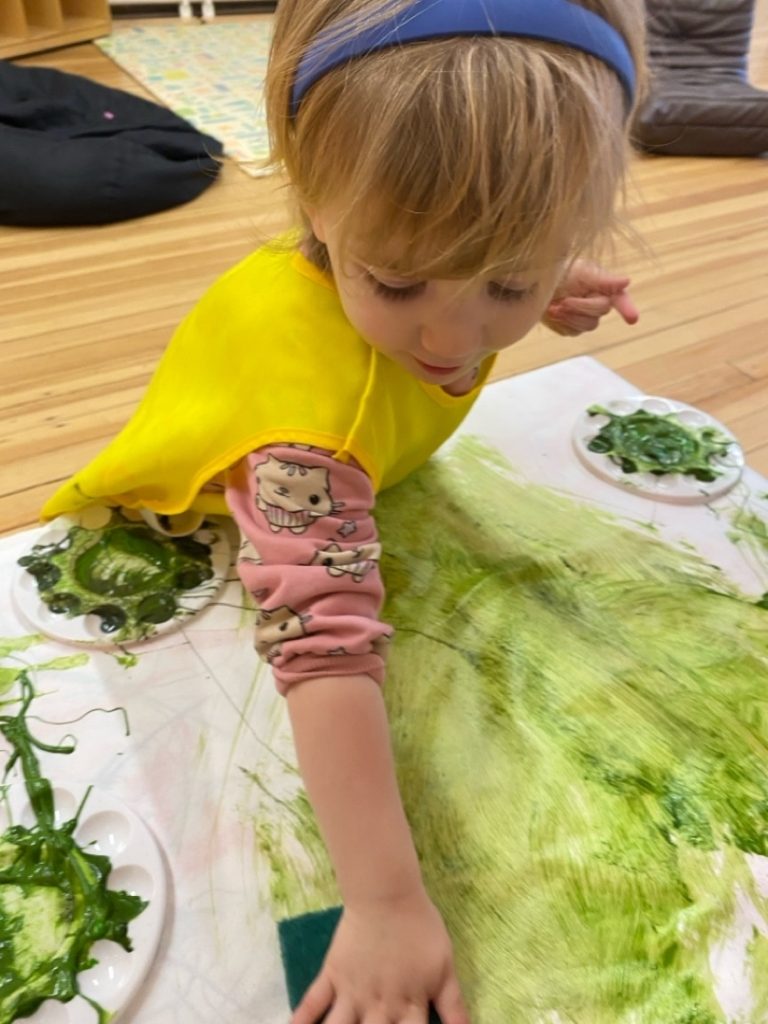
In a play-based classroom, mess is not chaos — it’s learning in motion.
Children Learn Best By Doing
Hands-on exploration is central to how young children make sense of the world. For infants, toddlers, and preschoolers, activities like mixing paint, pouring water, digging in soil, or shaping clay are more than play; they’re opportunities to investigate, experiment, and build understanding through experience.
These experiences help toddlers and preschoolers strengthen fine motor skills, build coordination, and develop problem-solving abilities, while also engaging multiple areas of the brain at once. Children learn to test ideas, observe outcomes, and adjust their thinking.
Messy play also creates valuable growth opportunities. When something doesn’t go as planned, infants, toddlers, and preschoolers are given the chance to pause, reflect, and try again—building resilience, emotional regulation, and confidence along the way.
It’s About the Process, not the Product
In our classrooms, the focus is not on producing a perfect craft or a polished end result. It’s about the process, the curiosity, the experimentation, the willingness to explore without fear of getting it wrong. When children are free to investigate materials and ideas, they begin to see themselves as capable thinkers and problem-solvers.
And just as important as the exploration itself is what comes after. Children participate in restoring their environment — wiping tables, rinsing brushes, and organizing materials. Through this, they learn responsibility, care for shared spaces, and pride in their classroom community.
Why this Matters
Childhood is not meant to be rushed or overly refined. It is meant to be experienced. When we allow room for exploration , even when it looks a little messy, we create space for growth that goes far beyond the surface.
So yes, there may be paint on their sleeves. But there is also confidence forming, curiosity expanding, and independence taking root.
And that is a method we believe in.
At Ethos, we provide high-quality childcare and early childhood education for infants, toddlers, and preschoolers in South Boston, MA. Our research-driven, nurturing approach supports each child’s development while partnering closely with families.
Looking for infant care, toddler daycare, or preschool in South Boston? Request more information here.
References
Cleveland Clinic. (2023, October 4). The benefits of sensory play (and 12 easy ideas). Cleveland Clinic. https://health.clevelandclinic.org/benefits-of-sensory-play-ideas
Head Start Early Childhood Learning & Knowledge Center. (n.d.). Designing messy play for infants and toddlers. U.S. Department of Health & Human Services. https://www.headstart.gov/publication/designing-messy-play-infants-toddlers
Palumbo, J. (2023, October 10). The power of sensory play in childhood development. Forbes. https://www.forbes.com/sites/jenniferpalumbo/2023/10/10/the-power-of-sensory-play-in-childhood-development
Mothercare Greece. (n.d.). Sensory and messy play: Their importance and benefits for child development. Mothercare. https://www.mothercare.gr/en/advice/sensory-and-messy-play-their-importance-and-benefits-child-development